

Journey assessment
Review the steps customers take from first contact to ongoing support. Identify where expectations and actual experiences diverge.
Help customers move confidently from their first interaction to ongoing support. AsonTech Solutions connects research, analytics, and practical workflow improvements around the moments that matter to your business.
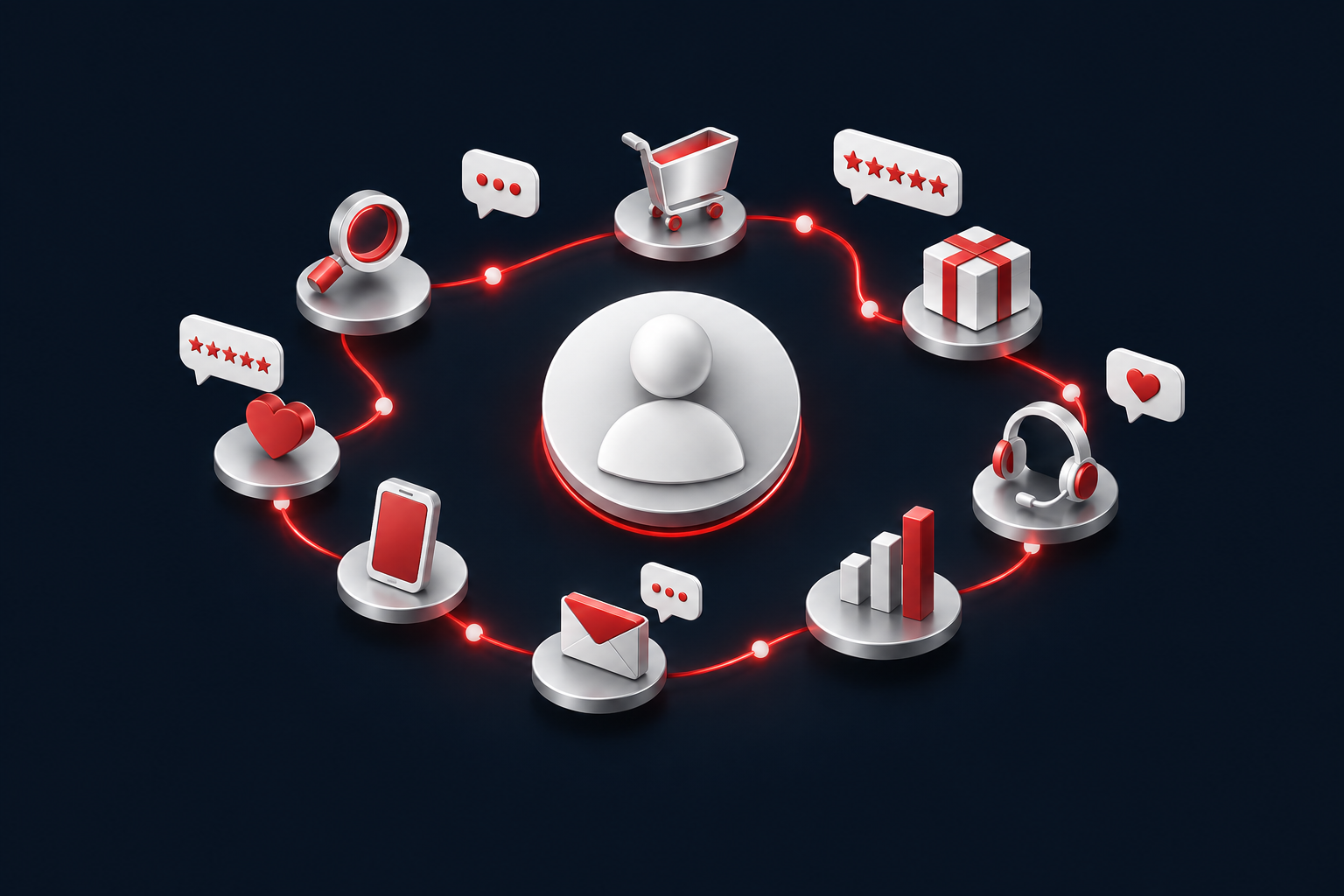
Connect customer needs with the systems and people responsible for meeting them.
Review the steps customers take from first contact to ongoing support. Identify where expectations and actual experiences diverge.
Bring product events and customer feedback into a useful picture of task completion, repeat contacts, and drop-off.
Plan how customer context passes between web, mobile, and support tools so people do not have to repeat themselves.
Help customers resolve routine needs with clear guidance and automation, while preserving a straightforward route to human help.
Organize support content, define review ownership, and make useful answers easier for customers and teams to find.
Review routing, handoffs, and agent workflows to identify avoidable effort and improve consistency in service delivery.
Bring customer feedback, operational constraints, and business priorities into the same conversation.
Focus the engagement on specific customer tasks and business priorities instead of a broad technology rollout.
Connect product behavior, communication, and support processes when evaluating improvements.
Agree on review routines, working-hour overlap, decision owners, and responsibilities from the start.
Establish a baseline and measurement plan so your team can evaluate whether each change is useful.
Share the customer concerns and operational challenges your team sees most often. We’ll discuss what to investigate and where a focused improvement could help.
Shared milestones keep business stakeholders and engineering teams aligned throughout delivery.
Review available feedback, product usage, and support records. Clarify data quality and what still needs to be learned.
Map the journey with your team and examine the handoffs and decisions that cause confusion.
Compare expected value, effort, dependencies, and uncertainty to select the next work items.
Update agreed workflows and integrations in reviewable releases, with clear ownership and acceptance criteria.
Use task testing or suitable experiments to check behavior and identify unintended effects before broader rollout.
Compare outcomes with the baseline, capture lessons, and decide what to adjust or investigate next.
Choose the balance of collaboration, responsibility, and scope your project needs.
Bring research, analytics, or workflow expertise into an existing product or customer operations team.
For a team with established ownership and ongoing improvement work.
Discuss this approachBring assessment, design, and implementation together around a shared customer journey.
For initiatives spanning several teams and releases.
Discuss this approachAgree on a focused assessment or improvement, with documented deliverables and milestones.
For an organization seeking a clear diagnosis or targeted change.
Discuss this approachCustomer needs made visible
Priorities grounded in evidence
Changes evaluated against a baseline
Ownership across product and support
Hire specialists across AI, web, mobile, cloud, data, and enterprise software.
See the application and platform work featured across AsonTech Solutions.
Answers about scope, data, measurement, and delivery.
CX optimization examines how customers experience your business across products, communications, and support. An engagement can include assessment, measurement, workflow design, integrations, and evaluation.
UX generally focuses on the experience of using a product or interface. CX includes the wider relationship, such as onboarding, billing communications, service interactions, and ongoing support.
Yes. We start with the current journey and the evidence available, then agree on a focused set of changes rather than assuming a complete replacement is needed.
Measures depend on the problem. They may include task completion, customer effort, repeat contacts, satisfaction, or retention. We define the baseline and interpretation before using a measure to evaluate progress.
No. Clear content, simpler workflows, and better handoffs may address the problem. Automation or AI should be considered only when it serves a defined need and can be evaluated appropriately.
We assess the limitations and identify practical ways to gather evidence, such as interviews, task observation, or improved event tracking. Recommendations should reflect the confidence of the available data.
Scope depends on the journeys, systems, research needs, and implementation effort involved. We agree on deliverables, dependencies, and milestones after reviewing your priorities.